Wednesday, March 05, 2008

New Security Certificates Law Escapes Both Public Scrutiny and Democratic Dissent

By Wade Deisman and Mike Larsen
When the Supreme Court last February declared security certificates to be unjust, the mood amongst the five men currently held by such certificates was cautiously optimistic, though a far cry from festive.

Although the high court concurred with the petitioners in finding the then-extant security certificate process unconstitutional, its judgment fell short of fully denouncing the practice.

The decision contained caveats that quashed any hope for the men's immediate release, and placed their fates in a kind of suspended animation.

In fact, the high court suspended applying its judgment for a year to allow lawmakers time to decide how to proceed, and even outlined some ways the process might be modified.

The high court said that a better balance between the state's desire to protect secret information and an individual's right to a fair hearing might be achieved by introducing a special advocate into the security certificate process.

The court reviewed a number of special counsel models, including the amicus curiae format used in the Arar Inquiry, the model associated with the Air India trial, the process used for secret information under the Canada Evidence Act, the British Special Immigration Appeals Commission (SIAC), and the Security Intelligence Review Committee (SIRC) model.

Of these, the court emphasised the last, which attempts to preserve an adversarial process, and was used for security certificate cases until 2002.

In the following weeks, those involved in the challenge called for a full public debate on the court-identified models identified. But the government remained silent, apart from indicating it intended to draft new legislation.

Such public reticence seemed initially understandable—arguably excusable. After all, some argued, the government ought to take time behind closed doors to weigh its options and formulate a strategy aimed at meeting the court-imposed deadline.

As time wore on, however, this allowance wore thin. Some began to suspect that silence itself was a part of the strategy.

The government, critics charged, was not dragging its feet so much as biding its time, waiting until the last possible minute to introduce new legislation and create an eleventh-hour scenario that would deter dissent by creating a situation wherein anyone associated with its expression might run the risk of being seen as sympathizing with the five men being held, or worse still, being responsible for setting them free.

Whether or not this allegation is true, the fact remains that by the time Bill C-3 reached the Senate, the court's grace period had very nearly expired. Faced with a do-or-die situation, those in the upper chamber saw fit to forfeit a full interrogation of the new law in the name of a higher duty.

Normally, this kind of legislation would receive at least four weeks of Senate hearings. Bill C-3 was dealt with in a single 10-hour session. In the end, the Senate's decision contrasted sharply with the submissions made by the hastily-compiled group of witnesses, the vast majority of whom expressed serious misgivings with both the bill's content and the truncated legislative process that produced it.

Indeed, the only submission to the Senate in support of the bill came from the public safety minister himself.

The new security certificates law was so expertly manoeuvred through the system that it largely escaped both Scylla of public scrutiny and the Charybdis of democratic dissent.

So Canada now has a new security certificate process, but at what cost?

One obvious price is confidence in the fairness and probity of the new process. The new approach is based heavily on the British SIAC model despite expert testimony favouring Canada's SIRC system.

It places limits on contact between the advocate and the individual subject to a certificate once the advocate has had access to secret information.

This will make it difficult to seek simple but potentially important clarifications from the named individual.

Additionally, while the SIRC model immediately grants counsel access to the full dossier of government information except cabinet confidences, the new Canadian model merely allows an advocate to ask that certain data be made available.

This means that advocates will have to engage in fishing expeditions to get material that is not introduced by the government but might be of value to the case.

It seems only a matter of time before the special advocate system is challenged before the Supreme Court.

A second cost lies in the missed opportunity for broad participation in both debate and problem solving.

At every stage in the legislative process, the government was presented with detailed and reasoned criticism of its proposal; and, at every stage, meaningful debate and the opportunity to revise and strengthen the bill was short-circuited by assertions that that hesitation would endanger Canada's national security.

Even if the security certificate system is procedurally fair, its intended outcome is still deportation. In each of the five existing cases, this would involve returning an individual to a state known to engage in torture, contravening Canada's international obligations.

What can we learn from the delayed tabling of C-3 and how it was rammed through Parliament? Not much that is particularly novel or even profound.

Canadian democracy is still highly susceptible to the politics of fear. The spectre of complacency in the face of an unspecified terrorist threat can be leveraged to tilt the field in favour of fear and push aside major reservations and misgivings.

And, perhaps, that the façade of urgency can be fabricated as a matter of stratagem, for there is nothing so unifying as the illusion of exigency and the fiction of a heroic, come-from-behind, saves-the-day effort in the name of securing the country.

Wade Deisman is director of the Ottawa-based National Security Working Group and has taught courses on terrorism, law and policing at the University of Ottawa. Mike Larsen is a PhD candidate in sociology at York University, and a researcher at the York Centre for International and Security Studies.

Thursday, August 16, 2007

The Power of Secrecy

By Wade Deisman
The story of Maher Arar and of his struggle to learn what role Canadian agencies played in his deportation and torture in Syria took one final, treacherous turn last week after originally redacted portions from the O'Connor report were finally made public.

The passages in question were redacted by the federal government on the pretence that ongoing investigations and/or agreements with allied security services might be compromised by their disclosure.

After their publication on Friday, however, it became clear that this was pure pish-posh, a cynical ruse aimed at shielding the already embattled security services from further infamy.

The patent lack of sensitive national security content in any of the declassified passages set pundits seething in indignation and commentators across the spectrum seemed to agree that the government's actions not only breached public interest, but compromised its essential integrity.

It is not hard to see what might have motivated the government to try to keep the passages in question classified. They are doubly damning in so far as they not only put the lie to the air of innocence maintained by the security services in relation to the fate of Arar, but also show that Canadian authorities were in much closer connection with the agency ultimately responsible for Arar's rendition than originally thought.

Indeed, at least one senior CSIS operative strongly suspected very early on in the whole saga that Arar had been targeted under the American transport-to-torture rendition program led by the CIA. Moreover, such suspicions were conveyed to CSIS high command but were not subsequently shared with the agency's political masters. Furthermore, the declassified portions make it clear that the CIA itself directly contacted the RCMP for intelligence on Arar shortly before he was subject to rendition. Finally, the declassified passages show that the RCMP complied with the request for information immediately and in full–sans the mandatory caveats and qualifications intended to safeguard the use of such information.

While Friday's revelations occasioned a great outpouring of outrage, almost no one professed shock or surprise. Aficionados of such affairs have a sense of how things work on the ground, and no one familiar with the intrigues of intelligence found the twin façades of innocence and ignorance donned by the RCMP and CSIS credible. For others, who had hoped the declassified information would bring clarity and closure to one of the most disturbing ordeals endured by a Canadian in recent memory, there was, at last, only disappointment.

The truth had been wrested from forces with a vested interest in concealing it only at great expense and in the end even the government itself had aided and abetted in its concealment.

It seems fairly certain that we have now been told all that we are likely to ever be told about the role that Canadian agencies played in the Maher Arar affair. Whether we will learn all that we can learn from the affair is, of course, another question entirely. For the great majority of Canadians, the ordeal endured by Maher Arar initially seemed like little more than an object lesson in how good intentions can have bad consequences. Today, however, it stands as a saga of bone-chilling proportions, a staggering cautionary tale about the power of secrecy, the evils of overzealous action, and the truly Herculean struggle necessary to wrest the truth from those who believe they are entitled to disguise, discredit or deny it.

Wade Deisman is director of the National Security Working Group and an expert on policing, intelligence, terrorism and national security at the University of Ottawa.

Tuesday, November 14, 2006

They're open, they're vulnerable, they're so-called soft targets..."

June 2006: The Harper government promised 95m for ‘measures that enhance the security for passenger rail and urban transit. At the time, that figure was considered ‘low key’ with RCMP training and the provision of firearms for border guards drawing the most attention. Yesterday 35 million of the promised 80 was ‘awarded’ to Toronto, Vancouver, Calgary, Edmonton, Montreal and the National Capitol Region, in ‘round one’ of Transit-Secure.

The program “allows for the reimbursement of eligible expenses, for the period of June 22, 2006 to March 31, 2008, and is subject to all expenditure controls applicable to contribution programs as per Treasury Board Transfer Payments Policy.”

The funds will support risk assessments, staff, training, equipment, and security audits. The costs will be shared at a ratio of 3:1 and the initial investment divided in this way:

- Montreal: up to $11,411,657

- National Capital Region: up to $1,178,288

- Toronto: up to $11,033,765

- Edmonton: up to $2,250,000

- Calgary : up to $811,875

- Vancouver: up to $9,859,590.

The Transit-Secure backgrounder contains more details on how city funds will be distributed by operator, since they will not be administrated by the municipalities. According to the backgrounder this round is the first of several “initial measures” including 24 million over four years to increase transport canada’s capacity, 8 million to allow PSEPC and Transport Canada to run urban transit preparedness exercises with operators and ‘stakeholders’ ranging from table-top to live runs, and a 3m, 2 yr PSEPC Public Safety Portfolio Task Force which will support local efforts to identify and cope with security issues.

Interestingly, the backgrounder mentions Madrid and London, but does not include the Dubai train bombings which were by far more expansive than either of them as cause to consider public transit vulnerable. It also contains a familiar imperative from the Transportation Minister: “Canada is not immune to the threat of terrorism. We must remain vigilant and continue to work with our partners in government and industry to address transit security issues.”

That statement was tellingly rephrased by the Vancouver Transit link representative as:

“I think what we're seeing in this announcement is that it's a kind of wake-up call for commuters that we are not immune [from terrorism], that we live in a global environment now,"

And by Wesley Wark, President of the Canadian Association for Security and Intelligence Studies on CBC.ca as:

"We could easily be a target for terrorist attacks," he said. "We've been named by al-Qaeda as a target nation, so while we might like to think we're not a likely target, you just can't gamble with that."

However, he added, no amount of money can make a transit system invulnerable.

"They're open, they're vulnerable, they're so-called soft targets, in the professional jargon," Wark said.

"You can do some things: You can have closed-circuit TV's that are a help; you can have a bit more visible security measures in terms of armed police and guards and so on.’

As of this afternoon, however, modifications to the spending were already being made. Ottawa announced that the National Capital spending would be decreased to about 900,000 and that CCTV was off the table until a needs assessment could be done. Although the NCR had recently experienced a series of violent events, the need for this spending is far from ‘demonstrable’.

In fact, the entire apparatus is cast in a curious light when spending in the Capitol is compared with that of Montreal’s 11m allocation. Although Montreal in particular has been slated for an extended CCTV program for some time an 11m initial payment seems excessive and will almost certainly draw fire for being political.

With time, we may in fact see the entire plan scaled down; the Ottawa needs assessment is unlikely to bear out funding for live-run disaster training. The second biggest ‘winner’ is Toronto, whose mayor, according to CBC responded by saying that there is ‘no real threat’ to Toronto Transit, but thanked the government for the extra funding anyway.

One thing that Canadians should take from this, is that so far from not being able to ‘gamble’ with the possibility that Canadian transit may be a target, more than a year after the London 7/7 transit bombings, and the subsequent manifestation of armed guards and dogs in Toronto stations, in most cities neither operators nor municipalities have conducted thorough needs assessments.

At the moment, Possibility, Likelihood and Actuality are dots so far removed in the security narrative – at least the public one – that funding allocation notwithstanding, transit security programs have a fair way to go yet.

Saturday, October 07, 2006

Normative Challenges in the Context of Transnational Anti-Terrorism: Some Lessons from the Arar Inquiry

© Mike Larsen, 2006

Contemporary terrorism is perceived as a phenomenon largely unbound by geography, and this has posed challenges for state responses, at both operational and normative levels. Multi-national and multi-sectoral cooperation in anti-terrorism, while demanding collaboration between actors, also gives rise to moral-ethical conflicts and barriers to effective accountability. These two issues – the transgression of norms and the problem of accountability – are fundamentally related, with the latter facilitating the former. I will discuss this through the example of the recently-concluded Commission of Inquiry into the Actions of Canadian Officials in Relation to Maher Arar (2006), and discuss the value of transnational criminology as a means to make sense of the Commission findings and to explore ‘conditions of possibility’ that might reduce the potential for future violations of this kind.

To begin, it is important to note a few salient features of the contemporary (post-September 11) national security context, as influenced by the US-led ‘war on terror’. Western responses to the perceived imperatives of the ‘new normalcy’ (Serfatay, 2002) have been characterized by broad expansions in the powers of policing and intelligence agencies, in the transmission of intelligence between states and between state and non-state actors, and in the general expansion of security portfolios. At a rhetorical level, these expansions have been couched in a state narrative that emphasizes themes of urgency, exceptionality, pervasive threat, and novelty; terrorism, in other words, is described as the most pressing threat to western states (CSIS, 2004), and one that demands us to ‘do something’ serious in response. At the same time, we are time and again told that the context in which this action must take place is essentially new and exceptional – the Canadian government prefers the term ‘new reality’ (PCO, 2004; PSEPC, 2005) – and that our responses must be equally novel and exceptional.

In Canada, one of the products of the post-September 11 state mobilization has been the drafting and implementation of the country’s first ever formal national security policy, ‘Securing an Open Society’ (PCO, 2004). One of the key themes of this policy document is the need to build an integrated security system (ibid, p.p. 9-14), whereby ‘key partners’ work in close collaboration, and share resources and information. This is a common characteristic of post-September 11 security policies, partly due to the perception that the September 11 attacks were the result of a ‘failure of intelligence’ caused by ineffective communication.

The emphasis on collaborative national security efforts has translated into a re-blurring of the operational boundaries between policing and intelligence gathering that were created following the 1981 McDonald Commission’s investigation into the practices of the RCMP (Friedland, 2001). Criminologists have described this blurring as a post-September 11 intensification of the relationships between ‘high policing’ and ‘low policing’ (ex. Brodeur & Leman-Langlois, 2006). At the same time, the common understanding of terrorism as a threat with “transboundary implications” (PCO, 2004, p. 16) has meant that intelligence-collection and sharing has an increasingly transnational quality. Information flows are multi-directional, fluid, complex, and governed by an array of agreements ranging from informal arrangements to contractual partnerships (Commission of Inquiry into the Actions of Canadian Officials in Relation to Maher Arar, 2004). Of critical importance, both national and transnational security intelligence practices are governed by an increasingly robust regime of secrecy, such that important mechanisms and arrangements are ‘protected’ from public scrutiny under national security confidentiality privileges.

The final report of Justice O’Connor in the Commission of Inquiry into the Actions of Canadian Officials in Relation to Maher Arar (2006) points to serious problems with the mechanisms through which security intelligence is gathered, evaluated, and transmitted – both internally and to other agencies – by the RCMP. Mr. Arar’s detention by US officials, rendition to Syria, and year-long torture and interrogation in that country provides a case study in the consequences of an approach to security intelligence that fails to pair the transnational flow of information with effective commitments to oversight and individual rights.

The Commission has found that the RCMP knowingly passed poorly-screened (and therefore inaccurate) information about Mr. Arar to American authorities, with the insinuation that he was a suspected member of the terrorist organization al Qaeda. In the immediate post-September 11 context, given the climate in the United States, this set off a chain of events that resulted in the decision to render Mr. Arar to Syria, and prolonged period of torture and interrogation there, during which time Canadian officials not only failed to take strong action to secure his release but availed themselves of intelligence products produced by his torture, and then attempted to cover up their actions (Commission of Inquiry into the Actions of Canadian Officials in Relation to Maher Arar, 2006, p. 14). The decision to render (extra-judicial transportation for purposes of national security or state-sanctioned kidnapping) Mr. Arar to Syria – as opposed to a Western country – was a deliberate one, designed to take advantage of the lack of restraints surrounding detention, interrogation, and prisoner treatment practices in that country. This reputation was well-known to the officials who made the decision, and to international human rights groups and governments. What was done to Mr. Arar in Syria could not have been done legitimately in Canada or the United States, due to established norms of conduct, standards of due process, and mechanisms of oversight. In the context of a transnational ‘war on terror’, however, it was possible for American (and Canadian) officials to circumvent these norms by outsourcing this particular aspect of the intelligence-gathering process.

In addition to the troubling findings of the Commission report, testimony from Canadian intelligence officials during the Commission hearings provides further illustration of the problems associated with ‘new’ (and pre-existing) forms of intelligence-gathering and sharing. Ward Elcock, former director of the Canadian Security Intelligence Service (CSIS) testified that “ all [security intelligence] services now increasingly, even larger ones, would recognize that they cannot secure their own security if you will by themselves; that the necessity is to have relationships with other organizations in the international sphere” (Commission of Inquiry into the Actions of Canadian Officials in Relation to Maher Arar, 2004, p. 90). Upon further questioning about the nature of these relationships, Elcock acknowledged that CSIS has a great deal of leeway in the development of information-sharing policies, both in terms of giving and receiving intelligence. Critically, CSIS enters into reciprocal intelligence-sharing relationships with states in the knowledge that the other party may have a dubious human rights reputation. Moreover, on the subject of the value placed on information that comes from torture, Mr. Elcock’s testimony indicates that not only is such intelligence not automatically discounted, but that CSIS as an agency does not have an official definition of torture, and therefore does not have an official legal basis for determining whether or not it is making use of the products of torture (Commission of Inquiry into the Actions of Canadian Officials in Relation to Maher Arar, 2004, pp. 213-216).

Clearly, the Arar Commission points to a number of very serious problems associated with the practices of ‘high policing’, intelligence gathering, and intelligence sharing in Canada and abroad – many of them the result of decisions to deliberately transgress or wilfully ignore norms through the mechanism of transnational cooperation. It also points to fundamental problems with the accountability and oversight of policing and security-intelligence actors in the contemporary context. The commission itself suffered from a severely-restricted mandate. It was empowered to conduct a fact-finding mission, and to offer recommendations in relation to the oversight of the RCMP. Members of other stakeholder agencies, such as Mr. Elcock, offered testimony, but the commission was not empowered to make recommendations about the governance of these agencies. Key parties in the affair – notably the American authorities and the Syrians – could not be compelled to provide information or indeed to participate, and Commissioner O’Connor notes that “In a few instances, however, I have been hampered by the lack of evidence of officials of these other countries” (Commission of Inquiry into the Actions of Canadian Officials in Relation to Maher Arar, 2006, p. 11). This is perhaps an over-generous statement; in point of fact, the Commission’s terms of reference reflect the absence of an empowered, transnational mechanism to provide accountability and oversight in such complex situations.

The relations of policing and intelligence-gathering that gave rise to the ‘Arar affair’ transcend the boundaries of traditional criminology in a way that is well-understood by scholars with a transnational focus. Wood & Kempa’s (2005, p. 297) discussion of ‘nodal governance’ captures this well, in that it recognizes the plurality of ‘auspices and providers’ that take part in the governance of new forms of policing. Rather than focusing on public-private dichotomies, a ‘nodal’ approach makes it possible to theorize the practice of policing as one that takes place at the nation-state level, above the nation-state level (Sheptycki, 1998, cited in Wood & Kempa, 2005), and at a ‘glocal’ level. It seems that just such an approach is needed to make sense of the new dimensions of policing and intelligence-gathering. The ‘Arar affair’ is perhaps best understood as the product of a set of relations between a loosely-governed (ad-hoc, even) network of policing and intelligence nodes. A proper study of these relationships would probably find that the experience of Mr. Arar was not an aberration, but rather an inevitable result of post-September 11 policy.

I propose that one of the reasons for this inevitability is the absence of effective oversight and accountability mechanisms for transnational security intelligence practices. In a complex and transnational system of relationships where the normative (and legal) constraints of one actor can be overcome through collaboration with other actors, where key arrangements take place under the veil of secrecy, and where the outcomes of decision-making processes have direct consequences for social control, transgressions of this nature are essentially built-in. Moreover, attempts to overcome this inherent complexity that remain bounded by traditional concepts and categories fail to address crucial underlying problems. In the case of the Arar Commission, this manifests in the possibility of a limited-mandate inquiry, with a strictly national focus that deals primarily with one actor (the RCMP). Actions taken to increase the oversight of the RCMP may have ripple effects on the other ‘nodes’ of the security-intelligence relationship, but this is altogether different that a reflexive, transparent, and democratic governance process.

Transnational criminological approaches can offer opportunities for expanded ‘governmental reflexivity’ – particularly through democratic accountability – in relation to security intelligence. This sort of intervention has produced successes in the field of public policing, notably in conflict areas such as South Africa and Northern Ireland (Wood & Kempa, 2005). As important as the success stories is the fact that the discipline of criminology is equipping itself to engage in and take ownership of such challenging problems of governance in the first place, as noted by Hardie-Bick, Sheptycki, and Wardak (2005), and Chan (2005). Exactly what forms effective security-intelligence accountability mechanisms might take is unclear, although the current problems suggest that a transnational, arms-length governing body able to contend with the plurality of actors and jurisdictions would be ideal. Viewed as a form of globalized inquiry that is attempting to move past the debate of relativism vs. positivism by acknowledging and adhering to commitments to human rights, transnational criminology seems well-equipped to explore the challenges of new security-intelligence relationships. This reflexive but post-relativistic commitment, expressed by Sheptycki (2005) through the recognition of the universality of harm, is particularly appropriate as a tool to challenge the deliberate normative transgressions that characterized the experiences of Maher Arar.

Thursday, September 21, 2006

Opacity in Cross-Border Security Politics

I'll revise this to add some analysis and additional material tomorrow, but I think it's important to get the basic information posted now.

This article, from the CBC, discusses an extremely high-level, closed-door conference that took place in Banff earlier this month. The subject of the conference was national security - particularly as regards the integration of Canada and US interests (energy policy was also discussed). Public Safety Minister Day was on hand, and it is reported that US Secretary of Defense Donald Rumsfeld provided the keynote address. The media was not informed of the event.

Maude Barlow, writing for the Toronto Star, provides a good analysis of the event, its implications, and exactly what is at stake here.

The importance of this event, considered in relation to our current security context, must be recognized. With the O'Connor report fresh off the presses, and ongoing legal battles and heated debates around issues such as Guantanamo Bay, detainee rights (in both countries), rendition, and information sharing, the need to bring deliberations about national security into the public sphere has never been more apparent. Bearing this in mind, and noting the series of problems (atrocities, constitutional violations) that have emerged in relation to secretive anti-terror practices, the decision to exclude the media (and public) from such a high level policy conference speaks volumes about the menality of our governments.

When 'national security confidentiality' is invoked to restrict access to information in the context of hearings such as the Arar Commission of Inquiry or the Security Certificate cases, we should be concerned, and more than concerned, about the status of our democratic values; but when the entire process of shaping the future of our security policy appears to be an 'invitation only affair' (with both the public and the free press having been left off the guest list), alarm bells should be ringing.

Decisions made in the near future will shape the future of Canada-US relations, border governance, privacy, information sharing, civil liberties, intelligence-gathering, and the nature of 'national security accountability'. Clearly, there are many stakeholders in these debates, including the citizens of both Canada and the USA. If we, as democratic publics, want our national security policies (policy?) to reflect our interests, it is incumbent upon us to engage in a real, open, and inclusive dialogue about security - as citizens, and not as consumers or subjects.

More to follow. Comments welcome.

Monday, September 18, 2006

"We're in a different world today than we were then. ... " - A Weeklong Daily Digest of Arar Commission Coverage

Three years in assembly, the Arar Report was released this afternoon. The NSWG is tracking the news coverage and will endeavor to provide a brief digest of some of the more interesting reports and commentary.

The NSWG is also maintaining a mailing list of updates for this week only. If you are interested in joining this list, email mlarsen@yorku.ca

Maher Arar’s long road to learning how and why he became a victim of torture in Syria culminated in an 855-page report (not yet available on the commission website, but promised shortly). In it he received the categorical exoneration he had been hoping for since he was detained by US officials. CTV has video of O’Connor and more coverage.

Early reports suggest, however that not all the expectations of Arar, and his interveners were met. O’Connor sharply criticized the RCMP for negligently sharing information from a database that had not been adequately scrutinized for accuracy and also failing to follow sharing restrictions that would have prevented his rendition.

Specifically, Mr. Arar was placed on a border ‘lookout’ list as early as October 2001 as part of an Islamic Extremist group thought to be linked to Al-Qaeda. O’Connor called this ‘extremely inflammatory’ in the days following September 11th and judged that the RCMP had ‘no basis’ for this assertion. The CP article reports that while he found that the RCMP did not aid or acquiesce in Arar’s removal, it ‘very likely’ supplied the information on which the US officials based their decision to remove him.

That finding in particular runs contrary to long held suspicions by some interveners in the proceedings including Alex Neve of Amnesty International Canada who were concerned about what they saw as a broader pattern of cooperation between Canadian, American and Syrian agencies to out-source intelligence extraction by torture. Specifically they cite a glaring lack of Syrian interests in the detention of Arar and fellow detainees Abdullah Al-Malki, Amahad El-Maadi and Muayyed Nureddin, and that the nature of the questions they say they were asked could only come from, or have been of interest to, Canadian intelligence officials.

For it’s part, the Toronto Star has reported that the RCMP has been preparing for the decision and is expected to say that the processes and standards have changed greatly since 2001 when Arar’s name was added to the watchlist. In anticipation of the report, federal lawyers announced that they would enter a two-day mediation for compensation in January.

Friday, September 15, 2006

Why We Fight Presented by Caucus


The Caucus political magazine is hosting its own film night at the Alumni Auditorium on Tuesday, September 19th. It is screening Why We Fight, a documentary about the development of the military industrial complex in the United States and its influence on both foreign policy and society in general. The NSWG will be in attendance and we encourage interested parties to do the same. The event notice is below:

Film Screening and Discussion featuring: WHY WE FIGHT
Go beyond the headlines and examine the anatomy of the American military-industrial complex.
When: Tuesday, September 19th at 7:30PM
Location: SAW Gallery (67 Nicholas, beside the Ottawa Hostel)
Admission: FREE
Refreshments and discussion afterwards at the Avant-Garde Bar (135 1/2 Besserer)

Thursday, September 07, 2006

"We Believe That The Threat Continues..."

It seems official. In an interview with the Financial Times, Kip Hawley, director of the TSA said that there is no timeline for removing the ban on liquids on aircraft, and that we can expect that it will ‘be in place for the indefinite future.’

Two weeks ago I bought a ticket on Delta, on an American airline, stopping in the continental US. As I waited for the travel agent to bring up my options, I sat on the edge of the fuchsia armchair. When I was told what my one best option was and while my head nodded, my stomach twisted.

A few weeks ago I had been in an itty bitty teeny tiny aircraft assuring the pilot that yes, the needle on the fuel meter was moving. I have calculated the risks of air travel and am not afraid of an aircraft, per se, although if you wanted to deal in hypothetical scenarios that might kill you, an aircraft is a good starter.

But what bothers me is not the trajectory of the plane, (although the sheer cost of the recent terror alerts and strain on the airline workers- Delta has recently been granted the right to cease it’s pilot pension program because it is under bankruptcy protection) but the trajectory of air travel, specifically the recent phenomenon of passengers taking it upon themselves to eject other passengers for being publicly unusual.

Take the very recent case of the Orthodox Rabbi on the Canada Jazz flight that was ejects because his (silent) praying and moving made them ‘uncomfortable’. This was only the latest in a series of incidents in which passengers, so long asked to be vigilant, ( if you see something, say something ) have now gone one step further and made their motto If You See Something, Do Something. Regardless of what that something is that you see.

Perhaps it is the legacy of United 93, five years later, that the thread of passenger empowerment has come through gut wrenching narrative, to TSA deputized air crew ( there are no less than 3 classes of people who are authorized to carry- and use- guns mid-flight) and the addition of newly trained ‘Israeli’- style behavioral profilers that has turned heightened vigilance into action, and customer service into paranoia- the airlines almost universally hold that no matter what, they ‘did the right thing,’ and Jazz, in particular states categorically that it ‘acted in the best interests of the majority of the passengers’.

But did it really? What on earth is so threatening about prayer? Did they suppose that he was really mixing a pair of mysterious but fateful liquids under his scarf, or trying to load a weapon that Canadian security is entirely sufficient to have screened out? Under that scarf lies the heart of the problem. It doesn’t matter what it is, it’s what it could be. And if it makes passengers uncomfortable, no polite questioning, no assurance, nothing short of removal of a paying passenger who is entitled to the same ‘comforts’ will do.

Since I bought my ticket, the passenger situation is not improved, and the director of the TSA believes that the risk is not much diminished. I will remember this when I pack my bag, and whether or not I forget and wander thoughtlessly up to security with a half-finished juice bottle in my hand, it is an issue I will deal with, and a threat assessment I will remember. It will be in the minds of my fellow passengers too as they look around them. That’s why my stomach twisted.

For a while, I entertained doomsday scenarios, that one misunderstanding would soon lead to a an armed marital deciding whether to open fire in the pressurized cabin while an F-16 flying just off the tail is likewise deciding whether to open fire ON a pressurized cabin. It’s happened a few times, but it’s not that likely, not really. Only one man has been shot, no planes have been fired upon. (although the CBC did carry a soundbite of the single US airforce pilot who had received the call to shoot down any remaining airliners on 9/11 and who described how, being unarmed, he intended to clip it with his own plane instead)

This concern is doubtless unfounded, and knowing this, I ought to be able to take some worried glances in stride. What *should* not sit well, with me, or indeed anyone in a democratic society, is the proposition that any handful of us can ban any one of us because of in-flight jitters and call ‘it in our best interests.’

Friday, September 01, 2006

The debate over the ethical treatment of geese

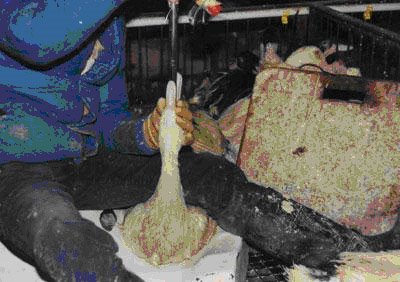
A Comment piece by Margaret Wente in last Saturday’s Globe and Mail informed me about the growing debate surrounding the City of Chicago’s decision to ban foie gras (or ‘fatty liver’, a French / Quebecois culinary delicacy composed of fattened goose liver). It seems as though a movement, grounded in animal rights advocacy, has successfully lobbied to have Chicago join the collection of cities and states (at least a dozen countries) that prohibit the sale of this dish, due primarily to the manner in which the geese are treated before being slaughtered. Specifically, the objections I have read in the newspapers and seen on television focus on the practice of force-feeding that creates the hypertrophied (read: huge) livers in the geese in question. Many animal rights groups (and obviously, a fair few politicians) feel that the practice of shoving a feeding tube down the throat of an incapacitated bird is barbaric, and has no place in a civilized city or society

Margaret Wente takes a look at both sides of this debate; the activists who support the Chicago ban, and the chefs, patrons, and farmers who argue against it for numerous reasons. She concludes her article by saying:

“We’re never going to turn into a society of vegans. But people increasingly
agree that animals have the right to a decent life before we eat them. I believe
our great-grandchildren will be astonished at how badly we once treated the
animals we eat, just as we’re astonished at how badly people once treated slaves
and women. Meantime, we’ll keep making deals with our conscience.”
Making deals with our conscience. Wente proposes that everyone has a line (of propriety in relation to the ethical treatment of animals), and that everybody draws their line in a different place. Some things are considered wrong by the vast majority of people in a given society, while others inhabit the grey area associated with foie gras, veal, and lobster dishes. Debate happens when our respective ‘lines’ come into conflict, and in some cases (as in Chicago) the state takes regulatory action.

I’m not sure about the foie gras thing. I’ve never eaten it, or felt inclined to, but I’m usually opposed to the state taking a micro-management position when it comes to normativity. On the other hand, some of the descriptions of the feeding process are troubling. A few descriptions should illustrate what I’m talking about. Bear with me. I have a point, and I promise it has to do with national security.

The National Post simply notes that foie gras “is commonly produced by force-feeding ducks and geese so that their livers increase by up to 10 times the normal size.”

Stephanie Brown, of the Canadian Coalition for Farm Animals, adds a bit more detail in her interview with CTV news: "It is a cruel product when an animal is force-fed with a metal pipe forced down its throat and a progressively larger amount of food and corn (is) being fed to these animals so that they become sicker and sicker,". CTV also notes that “animal rights groups argue that saying au revoir to the duck and goose liver delicacy is long overdue because it's a cruel product the world can live without.”

The sponsor of the Chicago bill banning foie gras, Alderman Joe Moore, told the Boston media that the ban isn’t about “telling people what to eat; this is basically a statement against cruelty to animals. This is a product of animal torture, pure and simple. It doesn't need to be on menus in Chicago."

One of the often-unspoken components of the anti-foie gras argument, and indeed most animal rights arguments, is the presumed and unquestioned innocence of the creatures in question. We kill and eat animals for nourishment (or enjoyment), but we ought not to do them unnecessary harm, as they deserve the best possible treatment prior to becoming our sustenance. After all, they have done no wrong (and can do no ‘wrong’, in the human sense), and our treatment of them is based on industrial demands, and not a compulsion to punish or judge. As such, an ‘acceptable minimum standard’ of treatment applies, and the concept of cruel and / or unnecessary abuses – such as force-feeding restrained geese with tubes – is often looked on unfavourably. Chicago says that such behaviour crosses the line, as does the state of Israel. Elsewhere, it’s subject to debate and contestation.

As I said, animal rights are a tricky issue, and I’m not sure where I stand on the ban. But I can agree with those who argue that the act of force-feeding a restrained bird against its will is distasteful – wrong, even.
What about force-feeding a restrained and conscious human against his will? Surely those who take a moral stance on this sort of practice when it comes to waterfowl would be the first to stand up and oppose a similar act when the subject is a living, thinking, protesting, human being, right? Surely those of us who are undecided about the propriety of forcibly inserting feeding tubes into the throats of immobilized livestock would find our ambivalence replaced with moral repugnance if it was a fellow person in the place of the goose.

Or would we?
Is it possible that our society can take a stand about the inhumanity of a treatment as it pertains to a bird, but turn a blind eye to the same treatment when it pertains to a human being?

I ask because the images I have seen and the descriptions I have heard in relation to the foie gras debate remind me of another recent situation where restrained subjects have had feeding tubes shoved down their throats against their will, only in this case, the subjects were a bit bigger, wearing orange jumpsuits, and members of the human race. I am referring to the detainees who have been held at the American Guantanamo Bay detention facility (and other detainees being held in places we know even less about).

For some time now, we have known that hunger-striking American detainees at Guantanamo have been subjected to force-feeding by military staff (not always doctors), using restraining chairs and nasal tubes. In June 2005, roughly 210 detainees went on hunger strike, demanding that the US military either charge them with some kind of offence or release them from custody.

On December 30, 2005, the UN Special Rapporteur on torture, Manfred Novak, told the BBC that “there There are credible allegations that Guantanamo hunger strikers are being force-fed in a cruel manner.” From the article: He told the BBC that he had received reports that some hunger strikers had had thick pipes inserted through the nose and forced down into the stomach. This was allegedly done roughly, sometimes by prison guards rather than doctors. As a result, some prisoners had reported bleeding and vomiting he said.

At the time, the Pentagon said that there was no evidence that the prisoners had been treated in an inappropriate way.

On March 1, 2006, The Washington Post reported on a 13-page legal filing by lawyers representing a Guantanamo captive. The filing claimed that their client “was tortured to coerce him into abandoning a lengthy hunger strike, and they contend that tactics used to force-feed detainees explicitly violate a new federal law [championed by John McCain] that bars cruel or degrading treatment of people in U.S. custody.”

The Washington Post further reports that the procedures being challenged

“include strapping detainees to a chair, forcing a tube down their throats, feeding them large quantities of liquid nutrients and water, and leaving them in the chair for as long as two hours to keep them from purging the food, according to detainee accounts and military officials. Detainees told their attorneys that the tactics, first reported last month in the New York Times, caused them to urinate and defecate on themselves and that the insertion and removal of the feeding tube was painful.”

Army Gen. Bantz J. Craddock, who leads the U.S. Southern Command, told reporters last week that the new techniques were designed to end the strike, but defended strapping detainees to the padded chair. He said detainees had devised a way to siphon the food out of their stomachs after they had returned to their cells, using the feeding tubes left inside them.
Newsstatesman.com provides some additional descriptors, for our edification:

Julia Tarver, whose law firm represents prisoners in Guantanamo Bay, stated that
at least two of their clients were being force-fed from tubes inserted through
their noses into their stomachs. Without anaesthetic or sedative, Yousef
al-Shehri was restrained by two soldiers, Tarver's testimony continued, "one
holding his chin while the other held him back by his hair, and a medical staff
member forcibly inserted the tube in his nose and down his throat". The result
of the force-feeding was that he and others were vomiting up "substantial
amounts of blood". […]After two weeks of this treatment, Yousef and other
prisoners were transferred from the hospital back to Camp Delta and placed in
solitary cells. Here they were given no food or water for five days before the
authorities resumed the force-feeding. This time the tubes were larger.
According to Tarver's statements: "These tubes - the thickness of a finger, he
estimated - were viewed by the detainees as objects of torture." After they were
removed he fainted: "Yousef described the pain as unbearable." The riot guards
(Emergency Reaction Force - ERF) removed these "Nasal Gastric (NG) tubes by
placing a foot on one end of the tube and yanking the detainee's head back by
his hair, causing the tube to be painfully ejected from the detainee's nose.
Then, in front of the Guantanamo physicians . . . the guards took NG tubes from
one detainee, and with no sanitisation whatsoever, reinserted it into the nose
of a different detainee. When these tubes were reinserted the detainees could
see the blood and stomach bile from the other detainees remaining on the tubes."
The head of the detainee hospital watched and made no attempt to intervene.
Another prisoner, Abdul-Rahman Shalabi, described similar incidents. "One Navy
doctor came," Tarver's testimony states, "and put the tube in his nose and down
his throat and then just kept moving the tube up and down, until finally
Abdul-Rahman started violently throwing up blood." The British doctor and
campaigner David Nicholl demonstrated how violent this procedure could be when
he had a tube inserted into himself by a fellow doctor outside the US embassy a
few weeks ago. Dr Nicholl said: "It is fundamental to a doctor's
responsibilities in dealing with a hunger strike that the detainee has the
right, as any other patient would, to refuse treatment." The US military, he
said, "defies this clear ethical obligation. The detainees are restrained with
shackles on their arms, legs, waist, chest, knees and head; are not
anaesthetised or sedated; and are subject to this practice as a further means of
torture."
Amnesty International and its subsidiaries have been decrying unnecessarily cruel force-feeding (and indeed, everything associated with the Guantanamo facility) since the story broke. They have campaigned effectively to bring issues related to Guantanamo before US courts, and a recent ruling (in the Hamden case) has barred the US administration from trying Guantanamo detainees in military tribunals. But the issue of force feeding has never been resolved. In fact, representatives of the US military have gone on record as saying that the hunger strike “is consistent with al-Qaeda training and reflects detainee attempts to elicit media attention and bring pressure on the United States government."

Jurist notes that US Army General Bantz J. Craddock, the military commander in charge of the Guantanamo facility has confirmed that military officials have been employing aggressive tactics – including restrained force-feeding – to deter detainee hunger strikes.

So let’s come full circle here.

People are lobbying with some success against the practice of force-feeding as it pertains to geese and in the context of foie gras production. The general argument against this practice is based on the contention that it is cruel and inhumane treatment, and that foie gras “is a product of animal torture, pure and simple”. Chicago has recently banned the product, as has Israel and a number of European states. Farmers argue that the force-feeding is necessary in order to produce a culinary delicacy.

Meanwhile, in Cuba, The US administration is using a disturbingly-similar process to deter detainees from hunger-striking (bad publicity) in the context of the ‘war on terror.’ Human rights organizations and lawyers have been screaming bloody murder about this, but real public and diplomatic pressure has not been effectively brought to bear. US officials argue that the force-feeding is necessary in order to prevent detainees (languishing in indefinite detention in a super-max facility) from taking their own lives in protest of their treatment.

I would go so far as to suggest that there are those who would stand up against foie gras but remain silent about the treatment of the Guantanamo detainees. It’s clear that the state of Israel has taken this position and probably a few others as well.

Clearly the two situations cannot be compared directly – on the one hand, there is an ethical debate over the treatment of livestock, and about the way that we as enlightened consumers comport ourselves in relation to animals that we breed for our consumption; on the other hand, we have a debate over the conduct of a state in relation to its very human prisoners, and the acceptability of certain interventions in the context of a complex conflict.

But when I read the articles on foie gras, I couldn’t help but think of the disturbing similarities between the plights of both the geese and the detainees at Guantanamo (who have been ‘out of sight, out of mind’ in the media for some time now). The common elements – restraint, resistance, confinement, force, power, powerlessness, and of course the feeding tube itself – allow us to juxtapose the two situations, and to ask ourselves what the differences really are.

At first glance, they are profound, at the levels of scale, context, and morality. Geese are not humans, ought not to be considered as humans (the reverse is true as well), and do not have the same rights as humans. They are animals, and most societies on the planet – even the most egalitarian and naturalistic – draw some profound ethical distinctions between humans and animals. Animal rights are not the same as human rights.

But in Guantanamo, the detainees are no more able to resist the feeding tube than the geese on a farm in Quebec. They are denied the right of resistance; in fact, they find themselves restrained and force-fed precisely because they have attempted to resist (through hunger striking, an age-old response to being imprisoned).

Of course, the US administration would laugh at the comparison, and so would many in the public. I would hazard that the administration would even take exception to my comparison of geese to humans – if anything, they might say, I should be framing the comparison as one between geese and terror suspects. And terror suspects (or detainees, or unlawful combatants) are not the same as you and me, right? They aren’t entitled to the same considerations, especially not during a ‘war on terror’.

In a way, the geese have a bit of an advantage, by virtue of their being ‘innocent animals’. As I mentioned earlier, when we have our enlightened debates about animal rights, even the pro-foie gras, pro-veal, pro-lobster camps don’t justify their positions by arguing that these creatures deserve condemnation, punishment, demonization, or repression. We assume innocence, and would be foolish to do otherwise, lest we imply that animals are equally capable of human morality.

In the name of Justice, we used to assume innocence in relation to people as well. Even when we had reason to believe that they were guilty, we used to recognize certain universal rights – to habeas corpus, to a fair trial, to representation, and even to resistance. In some countries, we still pretend that these are universal rights; pillars holding up enlightened society. But what does the situation at Guantanamo teach us about our commitment to universal standards of conduct and treatment? Why is it so easy for me to compare the situations of livestock and detainees? Governments have always been engaged in social control and political repression, but what we see in Guantanamo is different, and it is certainly viewed differently by many around the world. What we see in Guantanamo is a process of diminishing, whereby the things that signify common humanity are stripped away so utterly that there isn’t even a real attempt to conceal the process. No freedom; no charges; no trials; no convictions; no recourse; and absolutely no resistance. Ultimately, no humanity. And when you diminish people to the extent that you don’t even recognize them as humans anymore, there’s no limit to what you can do to them.

So when I read the articles last weekend about the ethical treatment of geese, and when I saw the words ‘humane’, ‘inhumane’, ‘cruel’, ‘torture’, ‘unnecessary’, and ‘wrong’ being employed, I was struck by the bizarreness of a society where enlightened debate about foie gras can lead to regulatory action and a government, acting on a mandate from the public, can treat human beings like animals.

Wednesday, August 16, 2006

Toothpase and Canaries

I have just recently returned from a terrific canoe trip in the middle of the mountains in BC’s Wells Gray Provincial Park. The scenery was wonderful, the weather was, on balance, very nice, and my computer, email inbox, and television were blissfully hundreds of kilometres away in Ottawa. When I arrived at a hotel in Blue River after regretfully leaving the lake behind, it didn’t take long before I had purchased the newspapers, opened my email, and turned on the television, where the first words I heard were from a CNN correspondent describing the characteristics of the ‘New, New Normal’ of aviation security. So much for hoping that my vacation would coincide with one of those rare pauses in the politics of terror and security.

WestJet helpfully filled me in on the immediate ramifications of the international panic that has followed the arrest of 24 (24 – 1, +1, for those keeping track) alleged homegrown terrorists in Britain (with more arrests in Pakistan). In my Inbox was the following email:


Dear WestJet Guest,

On Thursday, August 10, 2006, Transport Canada
announced increased security at all Canadian airports following a major
counter-terrorism operation in the United Kingdom.

As a result of
this situation, Transport Canada has implemented restrictions for carry-on
baggage. Until further notice, no liquids, gels or creams will be allowed on
board any aircraft, either on your person or in carry-on baggage. Liquids or
gels in containers of any size include: all beverages, shampoo, suntan lotion,
creams, toothpaste, hair gel, and other items of similar consistency. These
items can be placed in checked baggage but will be at the guest's own risk. Any
of the above mentioned items will be confiscated at pre-board security
screening. Guests may bring aboard baby formula, breast milk, if a baby or small
child is travelling. Prescription medicine with a name that matches the guest's
ticket, insulin and essential other non-prescription medicines are allowed. At
time of check-in, WestJet customer service agents will give guests the option to
remove any restricted items from their carry-on baggage and place them in their
checked baggage. These restrictions currently apply to all flights including
transborder into the U.S., domestic and international. Due to possible delays at
security screening, guests are advised to check in a minimum of two hours prior
to departure.


As it turns out, the alleged plot to blow up airliners on trans-Atlantic UK-US flights was to involve the use of liquid explosives, possibly nitroglycerin, nitromethane, or triacetone triperoxide. These explosives and / or combustibles were to be disguised as innocuous items of carry-on, such as soft drinks, in much the same way that can of shaving cream was supposed to help smuggle dinosaur embryos out of Jurassic Park (note that in our current state of hyper-reality, the lines between truth and imagery or simulation have blurred to such an extent that such comparisons are worryingly available and tempting to use – at least we were able to see images of the fake can in the movie). Accordingly, it was with a sense of detached absurdity that, this past Sunday, I went through the new ritual of sorting my luggage into solids, liquids, and gels, and ensuring that the latter two categories, along with my pocket knife and scissors, were dutifully checked for reasons of national security. As far as post-September 11 encroachments go, checking toothpaste and deodorant are relatively minor. Most of the major upsets in civil liberties, rights, and freedoms that have been experienced in the alleged pursuit of security over the last five years have been applied quite selectively, affecting certain groups, individuals, and locations; this most recent policy shift is receiving more attention because it represents one of those occasions where ‘we the people’ are collectively being asked to give up some very tangible examples of our enjoyed freedoms (however small) for the sake of national security. So far, it seems as though the public is generally willing to go along with the new policies, although I suspect things will be different if and when the rumored ban on carry-on electronics comes into effect.

So what’s the big deal? Why should we be concerned about the directive to purge our handbags of shampoo and soft drinks before boarding an airplane? As usual, it’s not the direct effects of the policy shift that should give us pause for alarm, but their location within a broader and ongoing trend in decision-making. This is very important to bear in mind, lest our arguments appear to be the lamentations of those who cannot bear to be separated from our hair gel while airborne.

As with any change in security policy or rhetoric billed as a response to a mobilizing event (or non-event, or potential event), efforts to unpack the implications of the ‘New, New Normal’ must be attentive to both the sequence of events and the larger socio-political context at play. Looking a short time back to the responses to the arrest of 17 alleged homegrown terrorists in Toronto is instructive, as it represents another situation where there connections between event (or non-event, or potential event), security response, politics, and public safety are indirect and somewhat fuzzy.

When the ‘Toronto 17’ were arrested, I was fascinated by the response from American authorities and politicians. As with the recent alleged aviation terror plot, the Toronto arrests were the culmination of a lengthy and extensive investigation, spanning countries, agencies, and jurisdictions. As with the recent alleged plot, the Toronto plot has been described as the work of homegrown, radicalized individuals. As with the recent plot, the Toronto case supposedly entered the arrest phase when authorities received intelligence indicating that the plan was nearing its operational stage – but before any operation was actually undertaken. And as with the recent plot, the nature of the alleged threat was well known to decision-makers, long in advance of the decision to disrupt the plan. Of course, there are major differences in the specific nature of the purported plots, in their scope, and in the key players, but the similarities are important to note, particularly as regards the ‘reaction and response’ phase.

In both cases, changes in policy – and calls for additional changes in policy – emerged after the disruption of the plot by authorities. After the June 2 arrests in Toronto, American border security was beefed up, and very political demands for sweeping expansions in security powers and changes in immigration policy were made by politicians on both sides of the 49th parallel. This is interesting, given that a) both American and Canadian authorities were aware of the investigation long before the arrests, and b) the threat posed by the alleged plot was, by virtue of the arrests, neutralized prior to the changes in policy (or requested changes in policy). If we understand the goal of security policies as the enhancement of public safety in the face of threats, then the expedient time to strengthen security would have been before the arrests, when the alleged plot was still ‘in play,’ and not afterwards. After all, the key decision-makers must have been well-informed about the ongoing investigation, as increased national and international intelligence-sharing is a cornerstone of both Canadian and American post-September 11 national security policies (and we have reason to believe that this exchange of information is actively taking place – the Arar Commission transcripts are illustrative of this) . It’s preposterous to assume that the American political reaction to the ‘Toronto 17’ arrests was the result of their post-June 2 surprise over the existence of the alleged plot. With a few exceptions (September 11, 2001 probably among them), intelligence and security authorities and the public do not operate along the same timelines, and what is new to us is not new to the key actors in politics and intelligence – in fact, it’s there job to know things we don’t, and to act on this knowledge before it reaches the public sphere. It sounds so obvious, but it bears keeping in mind every time we watch security agencies, politicians, the public, and the media reacting to events at the same time.

Fast forward to last Thursday, when transportation officials, airports, and security agencies rushed to react to the arrests in Britain. Again, the major ‘response’ to the disruption of the plot – the change in aviation rules and regulations – was implemented after it could have any impact on the organization or execution of the conspiracy in question. As was the case with the Toronto arrests, British (and Pakistani, and we can assume American and probably Canadian) authorities knew about the nature of the plot well in advance of its public unveiling, and as was the case with the Toronto investigation, they chose to withhold the implementation of preventative measures until post-facto, when the apparent danger had passed. The ban on liquids, therefore, is more a response to the publication of the apprehended British plot than it is a response to the plot itself. After the operation was thwarted, measures to prevent it were implemented, in airports around the world. Connecting the dots between event, reaction, security policy, and public safety is no easy task in this case.

An optimist would give the authorities the benefit of the doubt here. It could be argued that to take specific precautionary measures in advance of the arrests would have tipped off the alleged plotters, who could then have elected to change their tactics or simply go to ground. It could also be argued that the post facto response to the arrests is designed to prevent copycat or similar acts from taking place in the future, and that it is therefore a reasonable exercise in prevention. We could go so far as to suggest that the irritating nature of the precautionary measures taken was such that authorities felt it necessary for the nature of the threat to be illustrated before they could convince the public to cooperate.

When it comes to national security, however, I’m not an optimist (history, I would argue, instructs us not to be), and when it comes to matters of social control where liberties – anyone’s, no matter how small – are at stake, I don’t think it’s appropriate to give governments the benefit of the doubt. In fact, one of the key reasons we have civil liberties enshrined in constitutions and Charters in the first place is in response to the dangers associated with allowing states to exercise too much unchecked control over public life.

I don’t think that the new substance bans are simply the result of well-intentioned responses to a new and troubling face of terrorism; I don’t think that, in our contemporary ‘pre-emptive’ context, authorities need tangible examples of threats in order to enact policies in response to their hypothetical existence (case in point: terror alert levels); and I don’t think that the British arrests – or the global response to them – exist in a vacuum disassociated from global politics (particularly criticism within Britain – and in the United States - about increasingly intrusive security powers, the war in Iraq, and the public opinion minefield that is the Israel-Palestine-Lebanon situation).

But if the increased airport security is not the result of a cause-effect relationship between a foiled terror plot and government responses to the threat it posed, what is it?

Let me suggest an alternative interpretation that takes into account the chain of events and the broader socio-political context, and tries to get beyond the micro-level issue of toothpaste in carry-on baggage.

I propose that the new bans are the result of three inter-related factors: 1) an ongoing and pervasive tendency to embrace risk-based responses informed by probability neglect; 2) a similarly pervasive tendency to respond with technical solutions to what are manifestly social problems; and 3) a widespread (if not universal) willingness for states, authorities, politicians, and commentators to capitalize on the politics of fear. I’ll unpack each of these points in further detail:

1) an ongoing and pervasive tendency to embrace risk-based responses informed by probability neglect.

The new restrictions are preventative measures, designed to make it impossible for terrorists to board aircraft with disguised liquid or gel-based explosives. They were never designed to have any bearing on the alleged British plot (coming after the arrests), but they appear to be geared towards the prevention of similar activities in the future. In their sweeping and universal nature, they seem to embody the precautionary principle, which is usually interpreted by authorities to mean ‘better safe than sorry.’ Better to have all liquids banned than to risk having just one improvised liquid explosive incident. Quite apart from their political aspect (discussed below), I believe that the new restrictions reflect a widespread (and perhaps well-intentioned) trend to address unknown and often immeasurable risks by treating them as ‘knowns’ to be avoided. Cass Sunstein discusses this phenomenon in his book Laws of Fear. One of the problems with the precautionary principle is that it often relies upon emotional states (fear) and assessments of threats based on the availability of a worst-case-scenario (the prospect of a trans-Atlantic liquid bombing), which, in the absence of real data about the risks, produces probability neglect. Sunstein proposes that people fall victim to probability neglect if and to the extent that the intensity of their reaction does not greatly vary even with large differences in the likelihood of harm. The probability of an improvised liquid or gel-based explosive being smuggled on board an aircraft – particularly after the alleged plot to do just that has been foiled – is so low that sweeping precautionary measures are unlikely to ever have any bearing on a terrorist incident. The nature of the new regulations illustrate the abandonment of probability-informed response in this case, as they favour a universal ‘fix’ in the absence of data about specific variations in risk. This sort of ‘better safe than sorry’ approach is often embraced by a fearful public (unable to independently calculate risks), and it is actively championed by security authorities who feel pressure to ‘do something’ but are unable to act with any degree of informed precision. Sunstein points out that precautionary measures taken under the influence of probability neglect are not only unlikely to produce demonstrable benefits, but possibly sources of risk in their own right – he cites the appropriate example of sweeping and intrusive airport security measures resulting in more people choosing to drive, which is a much more dangerous form of transportation.

It’s important to note that both politicians and terrorists are effectively able to manipulate probability neglect in the public. From the political standpoint (more on this below), it pays to encourage the public to focus on the worst-case / crisis scenario, and to paint the picture of a pervasive and ever-changing terrorist threat that is both everywhere and nowhere. If a large part of your political platform relies on an omnibus national security agenda, the last thing you want the public to do is to treat terrorism as a concerning but rare and improbable phenomenon. From the perspective of terrorists, probability neglect in the public allows one action in one location to affect a massive audience by emphasizing the sheer randomness of the violence at play – the message is that ‘it could have been you,’ and, in the absence of data on which to assess the probability of this statement being accurate, many people exercise or support precautionary measures.

While taking informed precautions is, in many situations, a good thing, when pervasive probability neglect is in play, we are left with a decision-making process that embraces overreaction in the absence of evidence or verifiability, which I would suggest is a bad situation to be in when civil liberties and individual freedoms are at stake.

2) a similarly pervasive tendency to respond with technical solutions to what are manifestly social problems

Following from the first point, it’s important to acknowledge the close relationship between risk-based policymaking and technical responses in present-day society. Security has always been – to a certain extent - industrialized, and entire sectors of entrepreneuring specialists have made it their business to develop technologies in response to the latest risks. Airport baggage scanners, metal detectors, chemical trace identifiers, alarm systems, identity checks, biometric analysis, and a host of other gadgets and gizmos have been created (or re-tasked) to deal with emerging security issues. We can add to this list the less overtly technological aspects of technologies, as manifested by the various procedures designed to produce or maintain security, control, and order (as per Heidegger’s understanding of technology). The point is that we have generally elected to treat terrorism as a problem or hazard that can be mitigated with the appropriate application of technology, an approach that both pre-supposes the existence of terrorist plots and fails to really address their source(s).

By banning liquids and gels from carry-on baggage – and by implementing new techniques to screen for such substances – an additional layer of technological protection has been added to our anti-terrorism arsenal. As new plots emerge, similar technical solutions will no doubt be implemented (and embraced by the public), further strengthening our protections and ensuring that our authorities are always one step ahead of terrorists. After all, George W. Bush keeps telling us that “The enemy has got an advantage when it comes to attacking our homeland. They've got to be right one time, and we've got to be right a hundred percent of the time to protect the American people”, which suggests that ‘winning’ this particular conflict is a matter of out-imagining and pre-empting terrorists at the mitigation level. Makes sense, right?

Well, not really. It only makes sense if you put on blinders and treat terrorism as a technical problem, rather than a social and political problem which it obviously is (and always has been). This is not to say that all technical solutions are flawed – indeed, many are reasonable and appropriate. But terrorism can never be successfully responded to through technological measures (as with crime, as with other social problems), and attempting to deal with it in this manner only amounts to a proliferation of stop-gap solutions. Given the human capacity for innovation and the low-resource nature of asymmetrical warfare, it’s only a matter of time before a new terrorist plot reveals a new source of vulnerability, demanding a new series of responses and restrictions. And so on, and so on, ad infinitum, until the wholesale relinquishment of freedom becomes a prerequisite for travel. If terrorism and security are conceived of as two aspects of a technological ‘arms race,’ then the trajectory is set (there’s a reason they call it a ‘race’), and politicians will always be able to justify OUR escalations as necessary responses to THEIR threats.

William Saleton, writing for Slate, provides a cogent discussion of this problem in his article ‘The Liquid World’.

It’s high time that we stopped treating terrorism as something other than a serious social problem. If our response to the security challenges posed by political violence is to progressively prohibit the sorts of objects that can be used to disguise bombs, the result will only be increased insecurity and decreased freedom. Technical measures can be welcome additions to real, effective, political solutions, but they can’t be a substitute for them. For five years now (and before that too, of course), the proponents of conservative security agendas have scoffed at calls to address the ‘root causes’ of hatred and fundamentalism, to the extent that even mentioning the term ‘root cause’ (which itself has become diluted) brings about charges of ‘legitimization’ and capitulation. For five years, the status quo has been to treat terrorism as an inevitability or constant threat, like inclement weather, and to respond to it by alternatively shooting at the clouds or endeavouring to build the better umbrella. And now we have reached the point where our elected officials, busily pursuing their ‘war on terror,’ have decided to protect us by taking away our toothpaste, lest it be concealing some sort of ‘Mission Impossible-esque’ explosive. The whole thing would be comical if it weren’t so serious. Terrorism, we must remind our authorities, is not like the weather; it is not a constant ‘reality’ of any ‘new normal’ (at least, it doesn’t have to be); it is not a technological challenge to be surmounted with gadgets or restrictive policies; and it is absolutely not happening in a vacuum disassociated from our foreign policies. To the extent that we ignore the social and political wellsprings from which terrorism emerges, we resign ourselves to its continued presence, and to the erosion of our societies that is taking place in response to it.

3) a widespread (if not universal) willingness for states, authorities, politicians, and commentators to capitalize on the politics of fear

Perhaps banning liquids and gels on airplanes will have a preventive or deterrent effect on a terrorist plot someday. I’m not sure, and we really won’t ever be in a position to ascertain whether or not this is the case. But that’s only one aspect of the policy anyways. The other aspect, the one that we can readily observe, is the increase in the public awareness of terrorism-related threats that accompanies such a straightforward (and yet sweeping) response. Now, every time anyone prepares to take a flight, while they are sorting through their baggage, checking suspect substances, or reading new regulatory signage, they will be acutely aware that the threat of terrorism is as acute (maybe more acute!) than ever, and that even unassuming objects (we could substitute ‘people’ here) can be sources of deadly peril. If you’re a politician trying to advance an agenda that gives primary importance to national security (probably at the expense of other important things), this sort of active reminder of risk is very important – crucial, even – because you can only pursue an agenda grounded in protecting the vulnerable public if you take steps to scare the living hell out of them first. In the post-September 11 context, terrorism is always on the public radar to a certain extent, but when there’s a lull between events, or when certain security-related policies or foreign adventures become the subject of too much public debate and scrutiny, it sometimes becomes necessary to offer up new reminders and new nightmares, in order to keep the politics of fear moving in the right direction.

After any terrorist event, whether it be a successful operation, a thwarted operation, a major trial, or a good hypothesis about a potential operation, a policy window opens, and it becomes possible to interact politically with an anxious public. Changes in policy - particularly ones involving alterations to previously cherished rights or procedures – that would otherwise be difficult to effect become acceptable to a public anxious to see that ‘something is being done.’ Since September 11, this policy window has become an important feature in national and international politics, and progressively more restrictive national security powers and practices have emerged in Western states as politicians stack response on response, all the while emphasizing the immediacy and severity of the terrorist threat. It’s not a matter of conspiracy theory – it’s simply a reality of contemporary governance. Most political parties in most Western states agree on the essential talking points of the ‘war on terror,’ and today’s political battles are less about differences in interpretation of the essential sources of insecurity than they are about whose vision of the nightmare-response equation is superior. With tremendous expansions in the resources allocated to national security activities still underway, engaging in the politics of fear is a successful gambit for both politicians and stakeholders in the security sector.

In the case of the alleged UK plot (which is being described by many as ‘the worst terrorist plot since 9/11’, despite the fact that it never progressed beyond the planning stage), the arrests took place at a key time for both the British and American administrations. Both governments have been pushing for additional and controversial expansions in powers of policing, surveillance, intelligence-gathering; both governments have been receiving extensive criticism for the situation in Iraq, and for their role in the nascent civil war unfolding there; and both governments have been dealing with less-than-enthusiastic national and global opinion in relation to their stance on the hugely unpopular Israeli campaign in Lebanon and Palestine. In each of these situations, the key issues are very much nuanced, and the public in both countries is becoming resistant to the ‘black and white’ rhetoric that is favoured by the administrations. Recent controversies regarding botched terror investigations by British police, wiretap scandals in the United States, and the concerns surrounding biometric security technologies have intruded upon the status quo of ‘war on terror’ rhetoric. The foiling of an airline terror plot involving the UK and Britain can and has been used by claims-makers in both countries (and elsewhere, including Canada) to return the dominant narrative to a “Terrorists want to kill us and we need to respond to them” setting. Of course, it’s entirely possible that the plot was genuine – we won’t know until the accused have their day(s) in court. If the plot was genuine, then we are fortunate that it was foiled. The response to the unveiling of the operation does not require that the reality of the threat be proven in a court of law, though. Simply breaking the story to the media (who are all to ready to play their part in the propaganda process) is sufficient to ensure that the policy floodgates open, and the new regulations regarding liquids and gels are the result. These regulations are post-facto, and for that reason only loosely related with the alleged plot (which they were never designed to prevent), but they will for the foreseeable future serve as a means to conjure the spectre of terrorism in airports around the world.

Even if what we are witnessing is the result of a timely exercise in ‘fearpolitik’ and the unchecked expansion of risk-based technical responses to social problems, it’s hard to get worked up about something as apparently trivial as a ban on liquids and gels on aircraft carry-on. One would be forgiven for asking “What’s the big deal?”

It’s precisely this triviality that should give us pause for concern, in my opinion, because it effectively illustrates a more important and worrying trend in public thought regarding the relationship between security and freedom. The seemingly innocuous new regulations are a litmus test of sorts, and by examining the public reaction to them we can learn a great deal about the status of civil liberties. What I have seen over the last week is evidence of an apparent abandonment of the willingness to – on the basis of principle alone – defend against encroachments upon social freedoms described as necessary measures for the protection of national security. An alleged terrorist plot was foiled in the United Kingdom, and before the nature of the charges – let alone the outcome of any trial or the presentation of any evidence – was made public, the people of many democratic countries had decided to accept additional restrictions on their freedoms simply because the authorities deemed it necessary. When the policy floodgates opened, when public fear and the atmosphere of urgency were at their peak, we readily gave up something concrete in return for something intangible – and I submit that we did so largely because the real inconvenience associated with the new bans is relatively minor. In other words, we as a society (I include the people of the UK, Canada, the US, and other states here) demonstrated to the authorities that we are no longer in the business of fighting against encroachments on freedoms simply because they are encroachments on freedoms. I find this deeply troubling, because it seems to indicate a lack of understanding (or complacency) when it comes to the principles that underlie contemporary security politics. It sends the message that it is acceptable to subject individual freedoms to the death of a thousand cuts, so long as each cut is not deep enough to be unreasonable on its own. And it suggests that such ‘minor’ encroachments need not be justified to the public with evidence so long as they can be justified with rhetoric and imagery. These are the wrong messages to be sending governments that are, as we speak, pursuing policies that involve biometrics, CCTV, RFID, and expanded electronic surveillance. A society aware of the importance of defending civil liberties and individual rights on the basis of principle would have quickly made officials aware that this is about more than the ability to walk onto a plane with a can of soda – it’s about the right not to have one’s freedoms (however small) encroached upon as the result of arbitrary decisions of the state.


In closing, I think that our failure to appreciate the nature of the problem we’re facing (a politicized response to a social problem that relies on probability neglect and technical ‘fixes’ while continually encroaching upon individual and group freedoms – and advancing us towards further military adventures) is approaching the crisis point. The deadpan absurdity of the new set of airline regulations should serve as an illustration of the deep flaws in our approach to national (in)security, and the perilous position in which we have placed our liberties (however small).

I submit that we ought to treat the banning of liquids on aircraft as something of a dead canary in the mineshaft of contemporary security; in and of itself, it’s just a small bird, but its passing suggests something far more ominous ahead.

Thursday, August 10, 2006

Notes on the UK Terror Plot

The British HS John Reid showed still waters to the people of the UK as he described the ‘unprescedented’ terror plot, but his far stronger discourse only the day before, and the political currents in parliament churning underneath belie both the calm demeanor and the instruction being echoed in US UK and Canada alike: remain vigilant, but proceed as normal.

The revelation of an alleged plot to detonate ‘up to 10 flights’ (according to sources) with liquid explosives has sparked another round of feverish coverage, intensified security measures, discourses both heightened and carefully toned down from officials, and a sudden, though likely tenuous political unity. What appears to have changed that this ‘foiled’ plot appears to have incorporated features of a completed attack: a Red or Critical (immanent attack) threat level was issued for the US as well as the UK. (Although the US did restrict it to international flights) and the US also raised the threat level in what one BBC reported described as ‘slightly’ to orange.

Heathrow, Manhattan and Washington airports (at least) now have a greatly increased presence of armed officers, and the US has pledged a greater number of air martials to the UK-US route. Heathrow has taken the reportedly unprecedented step of banning liquids and obliging passengers to take their carry-on items in a clear plastic bag. Shoes are once again to be scanned. Although in his official statement HS Reid and the Transport Minister appeared adamant that passengers need only be patient and trust that the new measures would keep them safe, the BAA issued a warning to avoid Heathrow if possible, and British Airways cancelled all short-haul flights leaving Heathrow today.

Economic Fallout:

The markets are known for their dramatic swings, but by early afternoon, UK time, the Guardian reported a 4.5% loss for British Airways, and ripple effects are already reported for the Pound Sterling and the US dollar, the UK FTSE and reaching as far as the Bond Market as investors scramble to abandon their risky holdings. Like any market trend, it may signify a brief scare or a deeper disquiet, but it certainly reflects the speed at which conditions can change in the wake of even a ‘successful’ arrest. Perhaps the most telling market trend is an increased resilience in the face of terror ‘events’ over the past 5-7 years.

Conflicting Signals and Parallel Discourses

As always, authorities are faced with the dilemma of how to impress the public with the seriousness of the situation as they perceive it without creating panic. The statement by Reid was some of the earliest information I consumed this morning, and I was left, for the time being, with a strong impression that despite his terming the potential losses ‘unprecedented’, Reid had otherwise taken a very measured approach to the event. However, parallel articles published today by the Guardian detail a far more strident discourse presented to the Demos think tank yesterday that seem to parallel (although Reid’s remarks were far stronger) the heightened rhetoric that surfaced in Canada in advance of the terror arrest operation in Toronto.

Reid went as far as explicitly charge critics of anti-terror legislation with hampering police effectiveness and endangering the safety of Britons. He said that the UK faced the greatest threat to its security since the cold war, citing increased global mobility as a significant hole in UK measures. This type of statement is an allusion to the globalization-as-vulnerability and globalization-as-threat/NGO of terror discourse. The intended conclusion being that the threat is vast and ‘global’ and demands tighter, tougher response with a heavy bias on security measures over human rights. He noted elsewhere in the speech that the police are 100% dedicated, but not currently 100% successful in preventing terror. By a few accounts it appeared to have been calculated to lay the ground for yet more anti-terror legislation in the fall, and a further appeal against last week’s appeal court ruling in favor of the 6 Control Order detainees.

It sorts ill with today’s assurances of the travel secretary that travelers would be safe (those that did not heed BAA requests to fly elsewhere or whose flights had not been cancelled by British Airways) due to the emergency measures, and Chertoff’s statements that parallel alerts intensified measures in the US are only a matter of ‘prudence’. Naturally the July 21st London bombings must inspire all caution, but the wide range of measures and open ended statements do not denote a ‘routine’ securing of loose ends.

More to come: